|
Summary so far... Four main types of diminution have been introduced:
The neighbour notes on the previous page are in their most simple form - they are dissonant with the harmonic unit which the progression prolongs. Schenker shows how neighbour notes such as these can themselves be decorated by diminutions as long as the dissonant note is made consonant by being harmonised as in the example below. The D is still a neighbour note prolonging the harmonic unit of a C major chord, but it is harmonised by the dominant of C - namely G:
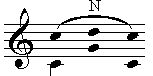 Here this harmonised neighbour note is decorated with its own diminution. In the example below, the neighbour note D is itself prolonged by a neighbour note - E.
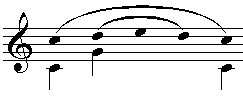 This will be explained more fully in the following pages but it is worth bearing an important concept in mind. The fact that a note from a diminution itself be decorated means that these patterns can be found below the surface of the music - hidden behind other diminutions. |
